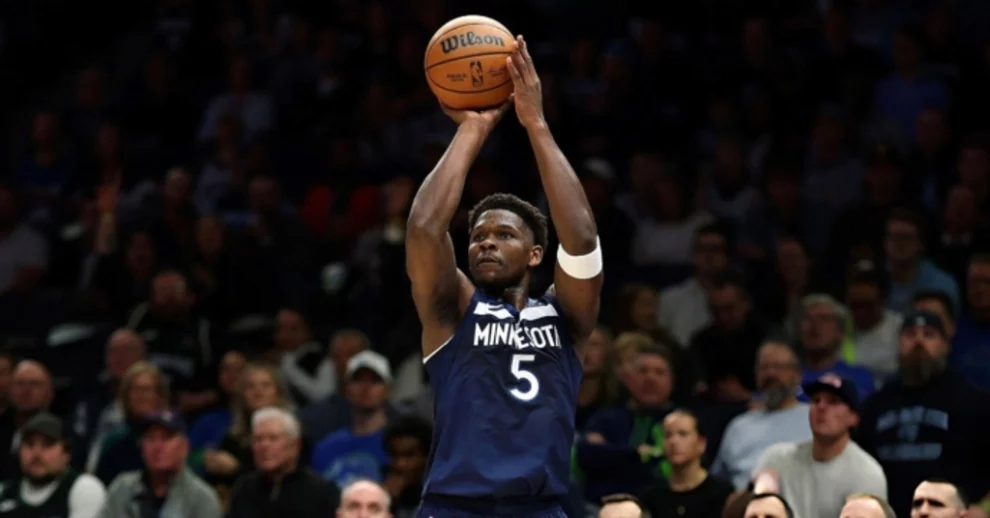
Anthony Edwards has already risen faster than nearly every young star in the league. He’s become an All-Star, a franchise cornerstone, and a playoff performer capable of matching the best players on the biggest stage. He has delivered fourth-quarter takeovers, silenced road arenas, and produced moments that signal a superstar in the making.

But for the Minnesota Timberwolves to reach new heights, Edwards must become something more—something bigger and more definitive.
If the Wolves hope to repeat or surpass their previous Western Conference Finals appearances, Edwards needs to elevate into an undisputed top-five player and produce an MVP-caliber season. It’s the clearest equation in Minnesota’s campaign, and also its most demanding one. Wherever Edwards goes, the Wolves follow.
This is not a criticism—it’s a reflection of the standard he has already set.
Minnesota enters the season with the same core: Rudy Gobert, Mike Conley, Jaden McDaniels, Naz Reid, Julius Randle, and Donte DiVincenzo. They are betting on continuity, trusting that their identity and elite defense will keep them among the NBA’s contenders. But continuity has limits, especially as the league evolves at unprecedented speed.
The Wolves know this. Edwards knows this. The leap must come from the player most capable of delivering it.
The Need for a New Level
Over the last two seasons, Edwards has shown flashes of his highest ceiling: elite rim pressure, shot creation in isolation, improved defense, and increased three-point volume. He has proven he can be the best player on a playoff team.
But the challenge now is elite consistency.
The Wolves need Edwards to reach the level of Nikola Jokic, Shai Gilgeous-Alexander, Giannis Antetokounmpo, and Luka Doncic—stars who erase the concept of a “bad game.” Even on off shooting nights, they bend defenses, control possessions, and dictate outcomes.
Minnesota’s defense is championship-level, but their offense stalls without Edwards. To elevate them, he must impact games even when the jumper isn’t falling: attacking the rim, trusting midrange looks, getting to the line, and creating for teammates with his gravity.
The next phase of superstardom requires more than shotmaking—it requires inevitability.
Why a Signature Move Matters
Every great scorer eventually learns not just what they can do, but what they can do every night. A go-to move—reliable, repeatable, and unstoppable.
For Edwards, this next evolution may come through developing a polished post-up fadeaway or midrange package. With his size, strength, and footwork, this could open an entirely new dimension to his offensive game.
It would anchor his scoring, force defensive adjustments, open passing windows, and stabilize Minnesota’s offense in tight moments.
It’s the same progression we’ve seen from the game’s greats: Shai’s midrange mastery, Jokic’s touch shots, Giannis’ drives, Kevin Durant’s pull-up, Luka’s step-backs, and Stephen Curry’s off-ball movement.
A signature move could push Edwards into that company.
Minnesota’s Ceiling Rests on Edwards’ Leap
There is an argument that Minnesota may have reached its roster ceiling. Their depth, defense, and chemistry are already elite. Gobert and McDaniels give them one of the strongest defensive foundations in the league. Naz Reid remains a unique spark. Conley steadies the offense. Randle adds creation and physicality.
But postseason success is dictated by star power.
Minnesota’s future hinges on Edwards’ evolution—not because he hasn’t been great, but because he must now be great every night.
If Edwards averages 30+ points, develops a signature move, reads the floor at a higher level, and reaches a superstar comfort zone where the game slows down, Minnesota’s ceiling rises with him. They become more than a strong playoff team—they become a legitimate championship contender.
Every recent champion had a clear top-five player:
Shai with OKC
Tatum with Boston
Jokic with Denver
Curry with Golden State
Giannis with Milwaukee
LeBron with Los Angeles
Kawhi with Toronto
If the Wolves want to join that list, Edwards must become that kind of player.
He has shown the flashes. Now comes the harder task: making those flashes the foundation.
This is where stars become megastars. This is where talent becomes legacy. This is where a young phenomenon becomes a franchise-defining force.
If Edwards takes that leap—if he masters consistency, adds a signature weapon, and enters the top-five conversation—the Wolves won’t just remain one of the league’s best stories. They’ll become one of its biggest threats.
Anthony Edwards doesn’t just hold Minnesota’s keys. He is the key. And if he reaches that level, the Wolves’ championship window opens wider than ever.